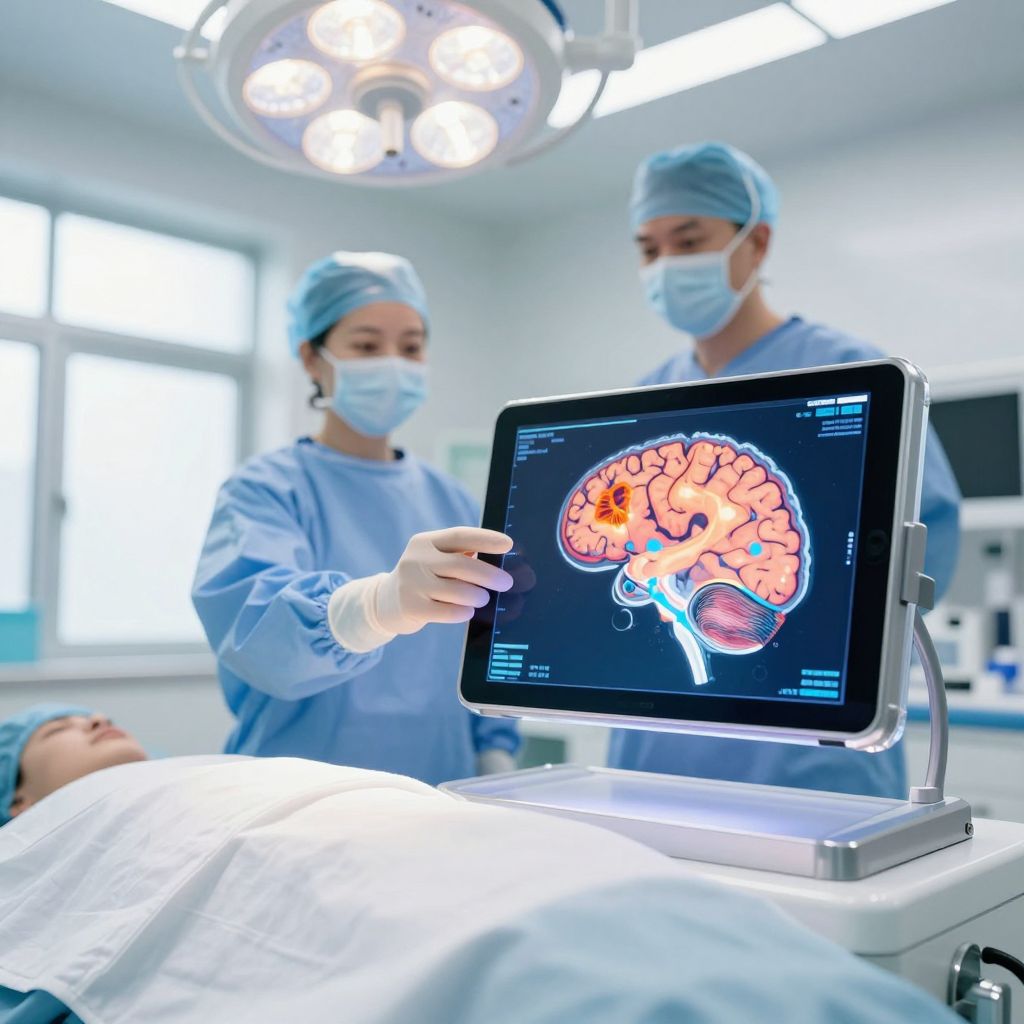
Artificial Intelligence achieves Dice scores of 0.82-0.84 in tumor segmentation and AUC values of 0.80-0.90 for molecular prediction
Artificial intelligence helps surgeons map brain tumors more accurately
This narrative review examines the integration of Artificial Intelligence in neurosurgery, focusing on tumor segmentation, molecular predict…
New tools use artificial intelligence to help neurosurgeons identify tumor boundaries and predict patient outcomes with high accuracy.

Serum neurofilament light chain serves as a robust biomarker of recent neuroaxonal injury in Multiple Sclerosis
Blood tests may help track nerve damage in Multiple Sclerosis
This guideline evaluates serum neurofilament light chain (sNfL) as a blood-based biomarker for multiple sclerosis. The evidence indicates sN…
A new blood marker called sNfL can help doctors see recent nerve damage and predict future disability risk in people with Multiple Sclerosis…

Combined plasma p-tau217 and tau-PET identify high-risk patients with hazard ratios up to 9.98
Blood Tests and Brain Scans Help Predict Alzheimer Disease Progress
This observational study of 330 cognitively unimpaired, Amyloid-beta positive older adults found that the T+ T+ biomarker profile predicted …
Combining blood tests with brain scans can identify which individuals are at the highest risk for rapid cognitive decline in early Alzheimer…

Diabetes mellitus acts as a context-dependent modifier of risk and phenotype in neurological disorders
Diabetes May Influence Risk and Progress of Neurological Disorders
This narrative review synthesizes evidence regarding the role of diabetes mellitus (DM) as a disease modifier across various neurological co…
New research suggests that diabetes can change how certain neurological conditions progress, potentially opening doors for new treatment opt…

Transcranial Magnetic Stimulation reduces motor overflow in focal dystonia and improves stroke and cerebral palsy outcomes
TMS Treatment Shows Potential for Reducing Motor Overflow
This systematic review evaluates the effects of transcranial magnetic stimulation (TMS) on various neurological conditions including stroke,…
Transcranial Magnetic Stimulation may help reduce involuntary movements in patients with focal hand dystonia and other neurological conditio…

Amblyopia impacts reading speed, eye movements, and crowding in patients with binocular vision disorders
Amblyopia slows reading speed and eye movements
This narrative review examines the impact of amblyopia and reduced viewing conditions on reading ability. The authors conclude that amblyopi…
Amblyopia can slow reading and disrupt eye movements, but no treatments target these reading problems yet.

Remote DWI lesions after intracerebral hemorrhage signal ischemic injury but mechanisms remain unclear
Remote Imaging Lesions May Predict Outcomes for Brain Bleeds
This systematic review examines remote diffusion-weighted imaging (R-DWI) lesions in patients with spontaneous intracerebral hemorrhage. The…
New imaging techniques can identify remote brain tissue damage in patients with a brain bleed, which may help doctors predict patient outcom…

AI-driven and traditional imaging markers provide a structured framework for predicting hematoma expansion in acute ICH
AI tools may better predict bleeding in the brain
This systematic review evaluates the evolution of imaging-based prediction methods for hematoma expansion in patients with acute intracerebr…
A new review shows AI methods may predict brain bleed expansion better than traditional scans, but hurdles remain.

Sex-specific genetic risk loci and causal proteins in Parkinson's disease
Identifying Sex Specific Genetic Risks and Brain Proteins in Parkinson Disease
A meta-analysis identifies 10 candidate proteins with sex-biased causal links to Parkinson's disease, highlighting GALC and PSMG1 in females…
New research reveals how sex differences influence genetic risks and protein levels in Parkinson's disease to help tailor future treatments.

Structured exercise training improves motor performance and modulates TMS neurophysiological markers in healthy adults
Structured Exercise Training Improves Motor Performance and Brain Markers
This meta-analysis evaluated the effects of structured exercise training on motor performance and TMS-derived neurophysiological markers in …
New data shows that structured exercise programs can improve motor performance and certain brain markers in healthy adults.

FDA Approves Belbuca (buprenorphine) Buccal Film for Severe Persistent Pain
FDA approves Belbuca film for severe pain that needs daily opioid treatment.
FDA approved Belbuca (buprenorphine) buccal film for management of severe and persistent pain requiring an opioid analgesic when alternative…
The FDA approved Belbuca (buprenorphine) buccal film for severe, persistent pain that requires daily, around-the-clock opioid treatment and …

DPP-4 inhibitors may reduce drug-resistant epilepsy risk via the gut microbiota and GLP-1 axis
DPP-4 Inhibitors May Offer New Hope for Drug-Resistant Epilepsy
This systematic review explores how DPP-4 inhibitors might mitigate drug-resistant epilepsy through a hypothesized gut microbiota-SCFA-GLP-1…
New research explores how a common class of medications might protect the brain and improve gut health in patients with drug-resistant epile…